The India 150GW solar milestone marks a turning point in the country’s clean energy journey. This article explains what the milestone means and the steps that will shape India’s path to solar sovereignty.
Table of Contents
Introduction

Success in life is the consequence of having a clear vision, being motivated, and setting goals. At the national level, the same idea holds true. India’s progress in renewable energy is not coincidental; it is motivated by ambitious objectives and smart planning.
The goal is now to achieve solar sovereignty by 2026, when India surpasses the 150GW renewable energy milestone. Particularly in areas like Tamil Nadu, leaders and innovators like Sanjay Kondaas are crucial to the development of a robust and independent solar industry.
In this blog, we examine how goal-setting and motivation fit with India’s solar aspirations and the tactics required to achieve energy independence. India’s energy transition will be guided by the 500GW Non-Fossil Capacity Target 2030.
Motivation: What Is It?
Motivation is what propels people, organizations, and even entire countries to take action. The need for sustainability, energy security, and economic prosperity are the driving force for India’s solar energy expansion.
Even lofty goals like the spread of solar electricity in India will remain unachieved in the absence of sufficient motivation.
Motivational Types: Intrinsic Motivation
A deeper purpose is the source of intrinsic motivation. For India, this entails cutting carbon emissions and using renewable energy sources to create a greener future.
Motivation from Without
External advantages like economic expansion, job creation, and India’s position as a global leader in the solar energy industry are examples of extrinsic incentive.
Setting Goals Is Crucial for Solar Growth
The key to India’s success with renewable energy is goal-setting.
The transition from 150GW to higher targets requires structured planning and execution.
The Advantages of Setting Goals
Provides Purpose and Direction
Clear targets guide the expansion of solar infrastructure in India.
Increases Inspiration
Milestones like achieving 150GW encourage further growth.
Improves Time Management
Deadlines ensure faster implementation of solar projects.
Encourages Innovation
Ambitious goals push advancements in solar technology.
Evaluates Development
Tracking installations and output ensures steady development.
Central funds are now normally credited to the beneficiary’s bank account within 15 to 30 days after the DISCOM issues the commissioning certificate, greatly streamlining the ₹78,000 Solar Subsidy DBTprocessing time in 2026.
How to Set Effective Goals for Solar Sovereignty
To achieve solar sovereignty by 2026, India must follow a structured framework similar to SMART goals.
SMART Objectives
Specific – Increase solar capacity and domestic manufacturing.
Measurable – Track gigawatt additions and installations
Achievable – Scale infrastructure with public and private partnerships
Relevant – Align with national energy security goals.
Time-bound – Set milestones leading up to 2026
An illustration of a SMART goal
Instead of saying, “Increase solar capacity,” a SMART goal would be:
“Add 50GW of solar capacity by 2026 through expanded infrastructure, increased rooftop installations, and strengthened distribution networks.”
Strategies to Achieve Solar Sovereignty
1. Visualize a Self-Reliant Energy Future
India must envision becoming a global leader in solar power generation and manufacturing.
2. Strengthen Domestic Manufacturing
Reducing dependence on imports is key to achieving solar self-sufficiency in India.
3. Expand Distribution Networks

The growth of solar panel dealers in Coimbatore and across Tamil Nadu plays a vital role in accessibility.
4. Invest in Technology and Innovation
Advanced solar technologies will improve efficiency and output.
5. Encourage Government Incentives and Policies
Faster uptake of solar energy is encouraged by supportive policies.
6. Promote Involvement of the Private Sector
Innovation and growth are being propelled by entrepreneurs like Sanjay Kondaas.
7. Pay Attention to Electrification in Rural Areas
Remote locations might receive dependable power thanks to solar technology.
8. Develop a Skilled Workforce
Project execution runs well when personnel are trained.
India’s shift from merely increasing capacity to attaining total energy independence through a fully integrated local value chain is reflected in the 2026 Roadmap to Solar Sovereignty.
Overcoming Obstacles to Reach Solar Objectives
1. Inadequate Infrastructure
It is crucial to increase grid connectivity and storage options.
2. Budgetary Restrictions
Large-scale projects need to be supported by funding and investment strategies.
3. Implementing Policies
Long-term success requires clear and consistent policies.
4. Competition in the Market
In the expanding solar business, striking a balance between price and quality is essential.
Achievement of surpassing the 150GW solar capacity milestone in India is unmistakable evidence that the National Solar Empire is now a reality rather than just a vision, accelerating our progress toward our 500GW target.
By adding a record-breaking 44.61 GW of capacity in FY 2025–2026 solar installation records, India accomplished a historic milestone in solar installation records, almost doubling the previous year’s performance and solidifying its position as a global leader in the energy revolution.
After adding a record-breaking 44.61 GW in a single fiscal year, India 150GW solar milestone on March 31, 2026, securing its place as the third-largest solar market in the world.
Motivation and Setting Objectives in All Important Domains
- Development of the Nation
Both economic expansion and energy security are aided by solar energy.
2. Growth in Industry
Sustainability and lower energy costs are advantageous to industries.
3. Impact on the Environment
Carbon emissions are greatly reduced by solar power.
4. Stability of Finances
Long-term financial gains are guaranteed by solar investment.
5. Social Advancement
The quality of life is enhanced everywhere there is access to clean energy.
Conclusion
A new chapter focusing on attaining solar sovereignty by 2026 has begun as India moves past the 150GW milestone. This vision is achievable with strong motivation, well-defined objectives, and strategic execution.
This change is being driven, particularly in important areas like Tamil Nadu, by leaders like Sanjay Kondaas and the expanding network of solar companies.
By continuing to be dedicated to sustainability, innovation, and methodical growth, India can build a self-reliant solar future. The path is clear. The momentum is strong. Now is the time to act and power the nation forward.
As of April 2026, India’s accomplishment of the 150GW solar milestone serves as the National Solar Empire’s definitive launchpad, making it more than just a statistical triumph. This roadmap has demonstrated that the transition from 100GW to 150GW was powered by millions of rooftops in towns like Coimbatore that have adopted the Sanjay Kondaas Vision of decentralized power, in addition to the enormous solar parks in Rajasthan. The route to sovereignty is evident, as the PM Surya Ghar Muft Bijli Yojana 2026 is currently enabling over 8.5 lakh household installations and counting.
Frequently Asked Question
1. What does reaching the 150GW milestone mean for the average Indian homeowner?
It marks a shift from energy dependence to Solar Sovereignty. With over 25GW of that total now coming from rooftop installations, it means the infrastructure and policy—like the PM Surya Ghar Yojana—are now robust enough for you to generate your own power, effectively becoming your own “mini-utility” and achieving a 25-year victory over rising tariffs.
2. How does the 2026 Roadmap impact the ₹78,000 subsidy processing?
The roadmap has prioritized the Direct Benefit Transfer (DBT) system. As of April 2026, the National Portal has been upgraded to resolve earlier OTP and syncing issues. In leading cities like Coimbatore, the timeline from DISCOM commissioning to subsidy credit in your Aadhaar-linked account is now targeted at a streamlined 30–45 days.
What the India 150GW Solar Milestone Means
Crossing 150 GW of installed solar capacity shows how far India has come in little more than a decade. It proves that large-scale solar is technically and commercially viable across the country. It also sets up the next challenge: India has committed to 500 GW of non-fossil electricity capacity by 2030, so the pace of growth needs to continue — and in some areas, speed up.
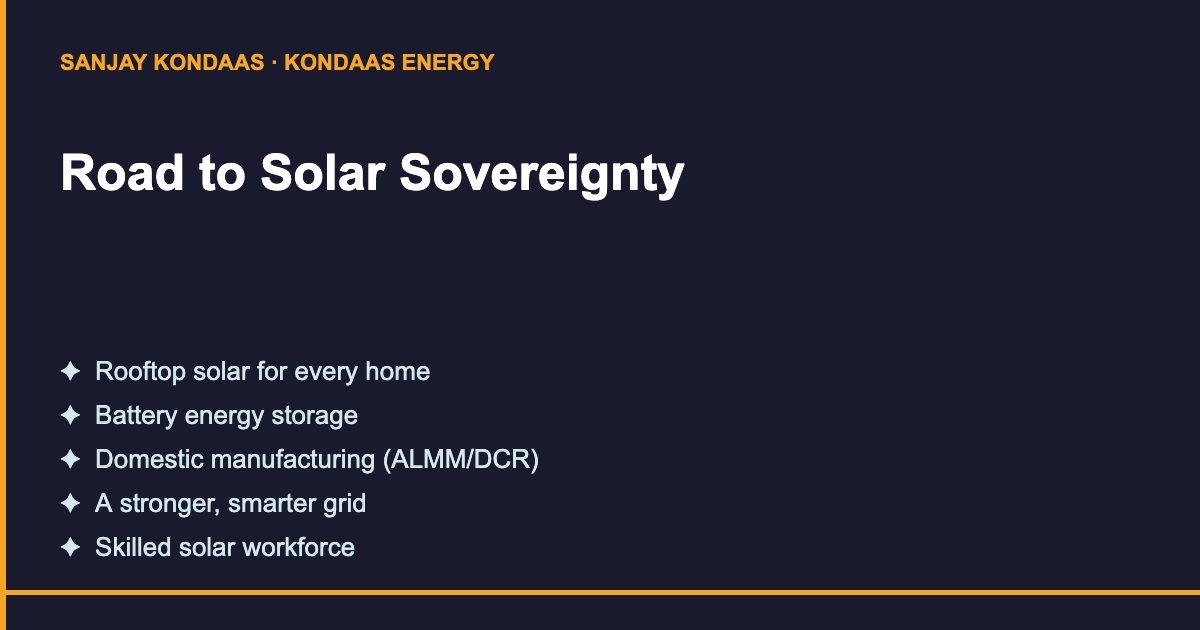
5 Essential Steps Beyond the India 150GW Solar Milestone
1. Rooftop Solar for Every Home
Utility-scale parks built much of the first 150 GW. The next phase depends heavily on rooftops. The PM Surya Ghar Muft Bijli Yojana aims to bring rooftop solar to one crore households, with central financial assistance for eligible homes. Distributed solar reduces transmission losses and puts savings directly into families’ pockets.
2. Energy Storage
Solar generation peaks at midday, while demand often peaks in the evening. Battery storage — at the grid level and in homes and businesses — is essential to make solar power available around the clock. Technologies such as LiFePO4 batteries are becoming more common for hybrid rooftop systems.
3. Domestic Manufacturing
Solar sovereignty means relying less on imported panels and cells. Policies such as the Approved List of Models and Manufacturers (ALMM) and Domestic Content Requirement (DCR) rules for subsidised projects are designed to strengthen Indian manufacturing across the supply chain.
4. A Stronger, Smarter Grid
More solar means the grid must handle variable generation. Investments in transmission, forecasting and flexible demand help integrate renewable power reliably, while net-metering frameworks allow rooftop owners to feed surplus power back to the grid.
5. Skilled People
Every gigawatt needs trained designers, installers and service technicians. Building this workforce — and raising awareness among future consumers — is as important as building factories and power plants.
How Local Solar Companies Contribute to Solar Sovereignty
National milestones are built one rooftop at a time. Regional companies play a key role in turning policy into working systems. In Tamil Nadu and Kerala, Kondaas Energy — founded by Sanjay Kondaas in Coimbatore — designs and installs on-grid and hybrid systems, supplies products through kPowers and offers LiFePO4 battery storage through Aurvo Energy. Kondaas has also trained more than 49,000 schoolchildren in solar awareness, helping build the next generation of solar users.
- For homeowners: check eligibility for PM Surya Ghar support and compare on-grid and hybrid options.
- For businesses: evaluate rooftop or ground-mounted systems to cut daytime power costs.
- For everyone: choose ALMM-listed components and reputable installers for long-term performance.
Official updates on solar capacity and schemes are published by the Ministry of New and Renewable Energy. For practical guides, see the MNRE solar subsidy guide and DCR rooftop solar rules and ALMM changes.
Frequently Asked Questions on the India 150GW Solar Milestone
What is the India 150GW solar milestone? It refers to India crossing 150 GW of installed solar power capacity, a major step in its renewable energy transition.
What is solar sovereignty? Solar sovereignty means meeting a large share of energy needs with domestically manufactured, locally installed solar power, reducing dependence on imported fuels and equipment.
What comes after 150 GW? Growth in rooftop solar, battery storage, domestic manufacturing, grid upgrades and skills development, in line with India’s 500 GW non-fossil target for 2030.
2 thoughts on “Beyond the 150GW Milestone: The 2026 Roadmap to Solar Sovereignty”