Intentional change means choosing to improve before circumstances force you to. For Sanjay Kondaas, founder of Kondaas Energy, intentional change is the practical side of believing that innovation is the only constant.
Table of Contents
Introduction
Innovation, vision, and constant execution are the foundations of corporate success. Sanjay Kondaas views innovation as a way of life rather than merely a tactic. His business experience serves as an exemplary model of how vision, flexibility, and goal-oriented leadership can transform concepts into successful endeavors. We examine Sanjay Kondaas’ business philosophy, how innovation influences his choices, and the tenets that underpin his long-term success in this blog. This guide provides insightful advice inspired by his experience if you want to create a firm that is ready for the future.
Innovation in Business: What Is It?
The capacity to recognize possibilities, find innovative solutions to issues, and consistently enhance people, processes, and products is known as innovation. Innovation is firmly anchored in long-term vision and purpose rather than immediate profits, according to Sanjay Kondaas’corporate philosophy. It enables businesses to remain resilient, competitive, and relevant in a changing market. Sanjay Kondaas’s Innovative Practices Aligning innovation with long-term corporate objectives and market trends is known as strategic innovation. Enhancing internal procedures to boost productivity and quality is known as operational innovation.
People-Centric Innovation:
Motivating groups to come up with innovative and growth-oriented ideas.
The Role of Innovation in the Success of Sanjay Kondaas A key component of Sanjay Kondaas’ exceptional entrepreneurship is innovation.
It has enabled him to overcome obstacles, create long-lasting companies, and keep ahead of changes in the sector.
Innovation in business is a survival strategy in 2026, not just a catchphrase.It isdescribed as the process of adding value by putting new concepts into practice, whether through a whole new approach to consumer outreach, a streamlined internal procedure, or a redesigned product. Innovation, as Sanjay Kondaas frequently states, is “intentional change”—a proactive move made to stay ahead of the curve as opposed to a reactive reaction to a crisis.
Innovation’s Advantages for His Business Philosophy
Drives Competitive Advantage:
In congested markets, innovation makes it possible to stand out.
Promotes Ongoing Development:
Innovative concepts result in fresh chances and growth.
Creates Long-Term Value:
Consistent advancement is guaranteed by sustainable innovation.
Boosts Leadership Impact:
Teams and stakeholders are motivated by creative thinking.
Adapts to Change:
Innovation enables prompt reactions to consumer and market demands. How Sanjay Kondaas Implements Innovation Without execution, innovation is nothing. Sanjay Kondaas uses a methodical, goaloriented strategy to turn concepts into outcomes.
It has made it possible for him to overcome challenges, build enduring businesses, and stay ahead of industry developments.
In order to guarantee organizational consistency, scalability, and long-term stability independent of any one person, processdriven leadership is a management style that places a high priority on the development and optimization of repeatable systems.
The Benefits of Innovation for His Business Philosophy
Drives Competitive Advantage:
Innovation allows one to stand out in crowded markets.
Encourages Continued Development:
New ideas lead to new opportunities for expansion.
Produces Long-Term Value:
Sustainable innovation ensures steady progress.
Increases Leadership Impact:
Innovative thinking inspires teams and stakeholders.
Adapts to Change:
Innovation makes it possible to respond quickly to market and customer demands.
Sanjay Kondaas’s Approach to Innovation
Innovation is meaningless without implementation.Sanjay Kondaas transforms ideas into results using a systematic, goal-oriented approach.
A company that prioritizes a core set of ethical ideals, such as sustainability, integrity, or social impact, is said to be a value-driven business. This ensures that every strategic choice and day-to-day operation serves a purpose greater than simply generating profit.
Conclusion
Innovation is a mindset that influences every choice, not a one-time endeavor.The business philosophy of Sanjay Kondaas demonstrates how innovationmay result in longterm success, powerful leadership, andsignificant impact when it is approached as a way of life. He has created a legacy based on quality and growth by fusing vision, discipline, and inventiveness.Success will come if you embrace innovation on a regular basis andremain dedicated to your objectives.
Final Thoughts on Future-Proofing
Sanjay Kondaas believes that innovation is essential to surviving in a constantly changing industry, not a luxury.He has made Kondaas Automation a national solar powerhouse by adopting the motto, “Pain is a force that will beget great things if driven in the right direction,” from a small local electronics dealer. Sanjay believes that there are three fundamental ideas that are essential to future-proofing success:
Adaptability Over Attachment:
He was successful because he was willing to change course, switching from UPS systems to solar energy long before it was “proven.”He demonstrates that stagnation, notchange, poses the biggest threat to a company. Systems Over Solo Performance: He made sure Kondaas Automation could expand consistently by putting a “System-First” mindset into practice.
Frequently Asked Question
1. What does Sanjay Kondaas mean by “Innovation is the Only Constant”?
Sanjay Kondaas believes that business survival depends on the ability to pivot before the market forces you to. His philosophy is rooted in intentional change—moving from traditional UPS systems to solar energy in 2012, when it was still considered an unproven “blind faith” market. For him, innovation isn’t just a new product; it’s a state of mind that embraces disruption as a growth tool.
2. What is the “Kondaas Way of Life” and how does it relate to business?
The Kondaas Way of Life is a holistic framework built on four pillars: Health, Wealth, Relationships, and the “Surrender Phase”.
Business Impact: He applies this by ensuring Kondaas Automation is “Radiating Happiness.”
Systems thinking:
He views chaos as a sign of a missing system, not a sign of growth. Therefore, he innovates by building “system-first” processes that allow the business to run independently of any single individual.
3. How does Sanjay Kondaas handle business failure?
Sanjay views failure as “feedback in sales” and a “lesson fee.” He often quotes that “Pain is a force that will beget great things if driven in the right direction.” This resilience allowed him to navigate the “50-crore crisis” in Kerala, where he transformed a daunting logistical nightmare into a blueprint for massive-scale residential solar deployment.
What Intentional Change Looks Like in Business
Most organisations change only when a crisis arrives — a new competitor, a policy shift or a drop in sales. Intentional change is different. It is a planned, continuous habit of spotting what needs to improve and acting early. In a fast-moving sector like solar energy, where technology, subsidies and customer expectations shift every year, intentional change is the difference between leading and catching up.
6 Proven Steps to Intentional Change
Step 1: Scan the Horizon Regularly
Intentional change starts with paying attention. Sanjay Kondaas keeps close watch on new solar technologies, regulatory updates and customer feedback. Regular scanning means changes are spotted as opportunities, not threats.
Step 2: Decide What Must Not Change
Future-proofing does not mean changing everything. Core values — honest advice, quality installation and reliable service — stay fixed. Knowing what to protect makes it easier to change everything else with confidence.
Step 3: Start Small and Test
New ideas are safest when tested on a small scale first. A new product, process or market can be piloted, measured and refined before it is rolled out across the business. This keeps risk low and learning fast.
Step 4: Bring the Team Along
Change fails when people do not understand why it is happening. With a team of more than 200 people across Tamil Nadu and Kerala, Sanjay Kondaas relies on clear communication and training so that every change is understood and owned, not merely announced.
Step 5: Build New Capabilities
Some changes require new skills or new businesses. The growth of the Kondaas group — Kondaas Energy for projects, kPowers for products and Aurvo Energy for LiFePO4 battery storage — shows intentional change in action: each addition responded to where customer needs were heading.
Step 6: Review, Learn and Repeat
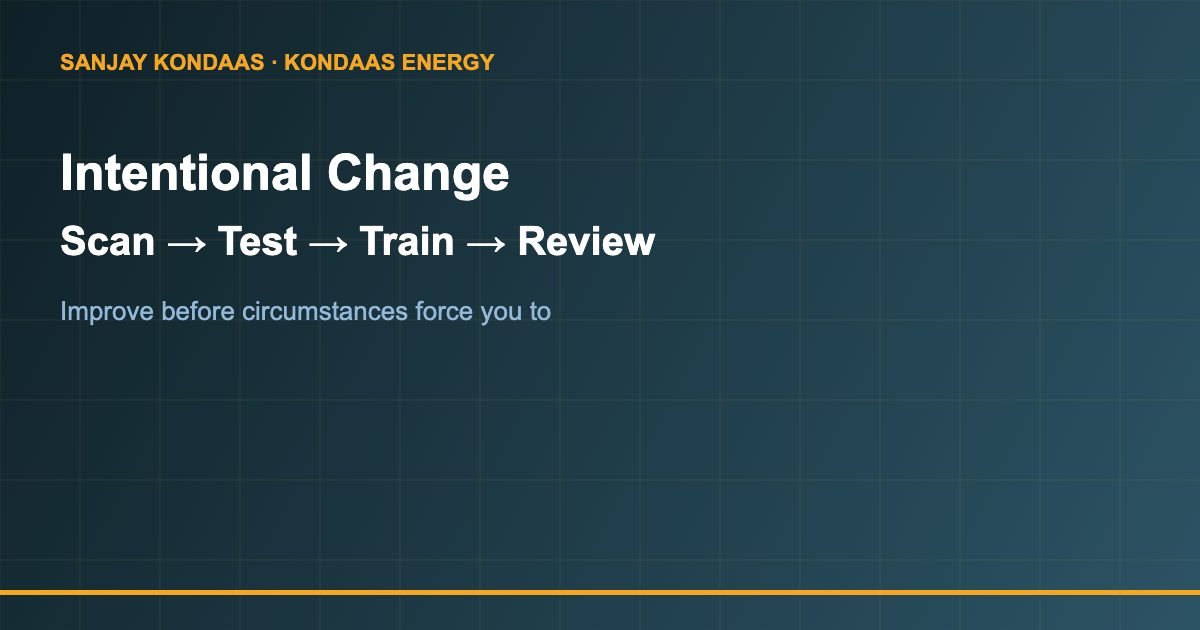
Intentional change is a cycle, not a one-time project. After each change, review what worked and what did not, then feed those lessons into the next improvement. Over 30 years, this steady cycle has helped Kondaas grow from a ₹10,000 start in 1995 into a trusted solar group.
Why Intentional Change Beats Reactive Change
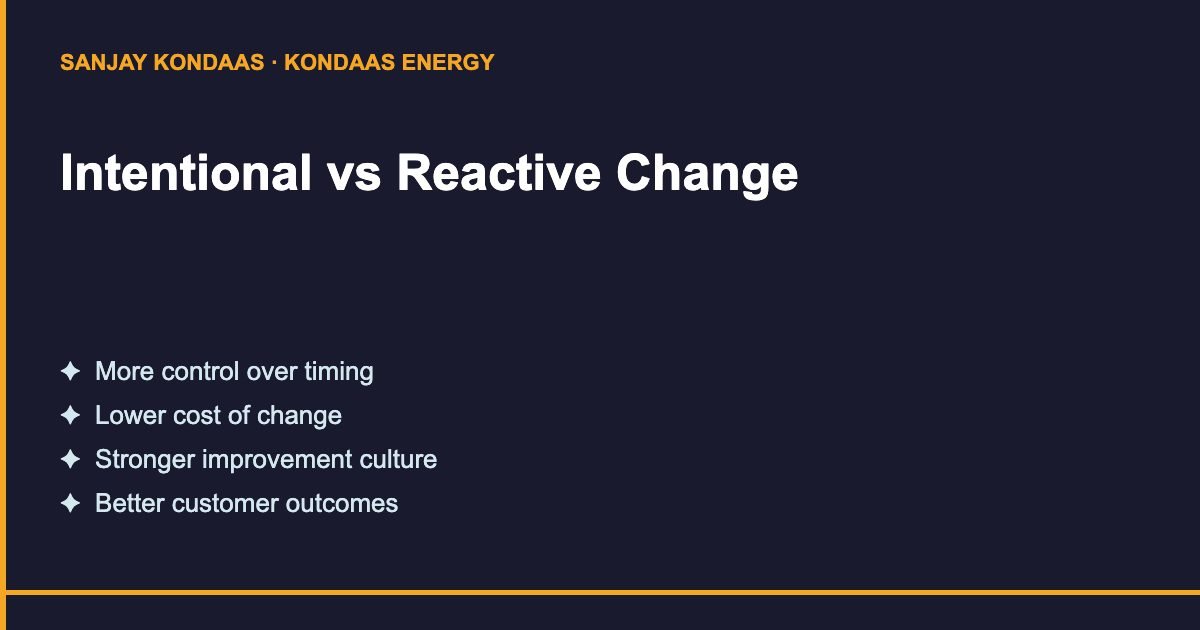
- More control: you choose the timing and scale of change.
- Lower cost: small, early adjustments are cheaper than emergency overhauls.
- Stronger culture: teams become comfortable with improvement.
- Better customer outcomes: customers benefit from new solutions sooner.
Change management research, such as the work summarised by Harvard Business Review, consistently shows that planned, well-communicated change is far more likely to succeed. For related reading, see process-oriented leadership and 5 proven strategic moves that turn vision into success.
Frequently Asked Questions on Intentional Change
What is intentional change? It is a deliberate, planned approach to improvement, where leaders act early rather than waiting for a crisis.
How does Sanjay Kondaas apply intentional change? By scanning for trends, protecting core values, testing new ideas on a small scale, training his team and expanding into new capabilities like battery storage.
Why is intentional change important in solar? Solar technology, policy and customer needs change quickly. Companies that adapt early can serve customers better and stay competitive.