Every leader wants to build a great team, but few have a clear method. These lessons, drawn from decades of experience in the Entrepreneurs’ Organization and Round Table, turn that goal into practical steps.
Table of Contents
Introduction
Creating a profitable company is never a one-person endeavour. A driven, talented, cooperative workforce with a shared vision is the foundation of any successful company. Building a strong team is crucial for long-term success, whether you’re a team leader, business owner, or startup founder. Organizations like the Entrepreneurs’ Organization (EO) and Round Table groups have shown over the past 30 years that the cornerstones of high-performing teams are communication, trust, leadership, and ongoing learning.
In this blog, We’ll look at effective team-building exercises, useful leadership techniques, and tried-and-true methods for fostering an environment where employees work together, innovate, and develop as a team.
Why It’s Important to Create a Great Team
One of the most powerful competitive advantages any company can have is a good team. Collaborative workers increase output, find solutions to issues more quickly, and support long-term company expansion.
The following are some main justifications for why creating a fantastic team is crucial:
Enhanced Efficiency
By leveraging the skills and abilities of each team member, a collaborative team completes projects more quickly.
Improved Interaction
Effective communication fosters departmental cooperation, decreases miscommunication, and increases transparency.
Increased Engagement of Workers
Workers are more inclined to produce their best work when they feel appreciated and supported.
Enhanced Innovation
Diverse viewpoints inspire original concepts, cutting-edge fixes, and ongoing development.
Lessons from 30 Years of Round Table and EO Experience
Constructing people is equally as vital as constructing products, as successful entrepreneurs often emphasize.
Prioritizing trust above performance
Every effective team is built on trust. Collaboration is easier and more effective when workers have faith in their managers and coworkers.
Serving others is the essence of leadership. Instead of dominating their teams, great leaders empower them. They eliminate barriers, offer direction, and generate chances for development.
Success Is Driven by Continuous Learning
Businesses that support skill development, learning, and mentoring often perform better than those that don’t.
Relationships Are Important
Collaboration, employee satisfaction, and long-term corporate success are all enhanced by strong professional connections.
Essential Characteristics of an Outstanding Team
It takes more than just recruiting gifted people to create a great team.
A Common Vision
The organization’s mission, objectives, and long-term goals should be understood by all team members.
Unambiguous Communication
Teams may avoid confusion and make well-informed decisions when there is open and honest communication.
Responsibility
Teams that are successful accept responsibility for their work and often produce outcomes.
Respect for one another
Respect for diverse viewpoints fosters an inclusive workplace where everyone is treated with dignity.
Flexibility
The business world is always evolving. Flexible teams take advantage of new opportunities and react swiftly to problems.
In order to foster psychological safety, create crystal-clear role clarity, and celebrate shared victories that strengthen a collaborative culture, effective team building strategies must go beyond surface-level trust falls.
Lessons in Leadership from Round Table and EO
A number of leadership concepts are regularly emphasized by seasoned corporate executives.
Set a Good Example
Leaders who exhibit honesty, responsibility, and professionalism are more likely to be followed by their staff.
Prior to taking the lead, listen.
Good leaders actively hear what their staff members have to say, comprehend their worries, and respect their opinions.
Boost Your Ability to Make Decisions
Have faith in staff members to make choices that fall within their purview. Empowerment boosts self-assurance and responsibility.
Develop Future Leaders
Instead of depending on a single leader, cultivate leadership abilities across the entire organization. Long-term business continuity is ensured by robust leadership pipelines.
By integrating peer-tested structures—such as agile workflows and forum-style feedback loops—directly into their company culture, entrepreneurial leadership frameworks enable founders to transition from disorganized daily micromanagement to scalable growth.
Advantages of Forming an Outstanding Team
There are several long-term benefits for organizations with high-performing teams.
Increased Efficiency
Teams that work together finish projects more quickly.
Enhanced Client Contentment
Stronger client relationships and improved customer service are the results of engaged staff.
Increased Staff Retention
Employee turnover is decreased by a positive company culture.
Enhanced Innovation
Diverse teams come up with innovative solutions and quickly adjust to changes in the market.
Long-Term Business Development
Over time, strong teams continuously produce improved business performance.
How to Create an Outstanding Team
It takes deliberate leadership and persistent work to build a high-performing team.
Employ the Correct Individuals
Hire people who share your company’s values, have the skills you need, and show a desire to learn.
Search for:
A positive outlook
The capacity to solve problems
Communication abilities
A philosophy of teamwork
Flexibility
Build a Robust Corporate Culture
Collaboration, trust, and employee satisfaction are all boosted by a positive workplace culture.
Pay attention to:
Integrity and Transparency
Respect
Constant improvement
Joint achievement
Establish Specific Objectives
All workers ought to comprehend:
Personal obligations
Team goals
Business priorities and performance standards
Accountability and concentration are enhanced by well-defined goals.
Promote Cooperation
Give staff members the chance to collaborate by:
Meetings of the team
Cross-functional initiatives
Sessions of brainstorming
Sharing of knowledge
Innovation is enhanced, and relationships are strengthened through collaboration.
Since exceptional leaders actively create cultures based on trust, vulnerability, and unambiguous alignment so that individual talents can merge into a high-performing unit, true leadership and team building are inexorably interwoven.
Conclusion
One of the most important abilities for every business owner is learning how to create a fantastic team. The value of trust, communication, teamwork, and ongoing learning is emphasized by the leadership lessons learned over thirty years of EO & Round Table experience. Organizations may create teams that regularly produce exceptional results by employing the right people, fostering a great workplace culture, empowering employees, and acknowledging accomplishments.
Great teams create great enterprises. Invest in your employees now, cultivate deep connections, and establish a setting where everyone can prosper. Your team’s strength is the first step toward your organization’s success.
Looking back over three decades across Round Table and EO, the single greatest truth I’ve uncovered is that you cannot build a monumental business alone; you can only build the team that builds the business. The frameworks, peer vulnerability, and shared wisdom of these networks all point to a singular, undeniable reality: leadership isn’t about having all the answers, but about creating an ecosystem where the right people can find them together. As you look at your own organization today, remember that your culture is your ultimate legacy.
Frequently Asked Question
1. Why is building a great team important?
A great team improves productivity, encourages innovation, enhances employee satisfaction, and contributes to long-term business success.
2. What are the key qualities of a high-performing team?
Successful teams demonstrate trust, effective communication, accountability, collaboration, adaptability, and a shared vision.
How to Build a Great Team: 7 Proven Steps
1. Hire for Values, Train for Skills
Skills can be taught; attitude and values are much harder to change. Look for people who share your commitment to honesty, customer care and learning.
2. Make Roles and Expectations Clear
Confusion about who owns what causes most team friction. Define responsibilities, decision rights and success measures for every role.
3. Onboard With Care
The first weeks shape how people feel about their work. Structured onboarding — introductions, training, a buddy and early wins — helps new members contribute faster.
4. Build Trust Through Consistency
Trust grows when leaders do what they say, treat people fairly and admit mistakes. Consistency on ordinary days matters more than inspiring speeches.
5. Create Regular Team Rhythms
Short weekly meetings, monthly reviews and quarterly planning keep everyone aligned. Predictable rhythms reduce surprises and give people a voice.
6. Give Frequent, Honest Feedback
Feedback works best when it is timely, specific and balanced. Encourage feedback in both directions — leaders learn a lot from their teams.
7. Recognise Good Work
Public appreciation for effort and results builds morale and shows everyone what great work looks like.
What Peer Networks Teach About Teams
Organisations like the Entrepreneurs’ Organization and Round Table bring leaders together to share honest experiences. A common lesson from these forums is that team problems are usually leadership and system problems in disguise. Leaders who fix processes, communicate clearly and invest in people see stronger teams over time.
Sanjay Kondaas, founder of Kondaas and a member of EO who has served as Chairman of Roundtable India, has grown his organisation to more than 200 people across Tamil Nadu and Kerala — a reminder that great teams are built deliberately. Read more in leadership lessons from training 49,000 schoolchildren and chaos is a missing system.
Warning Signs Your Team Needs Attention
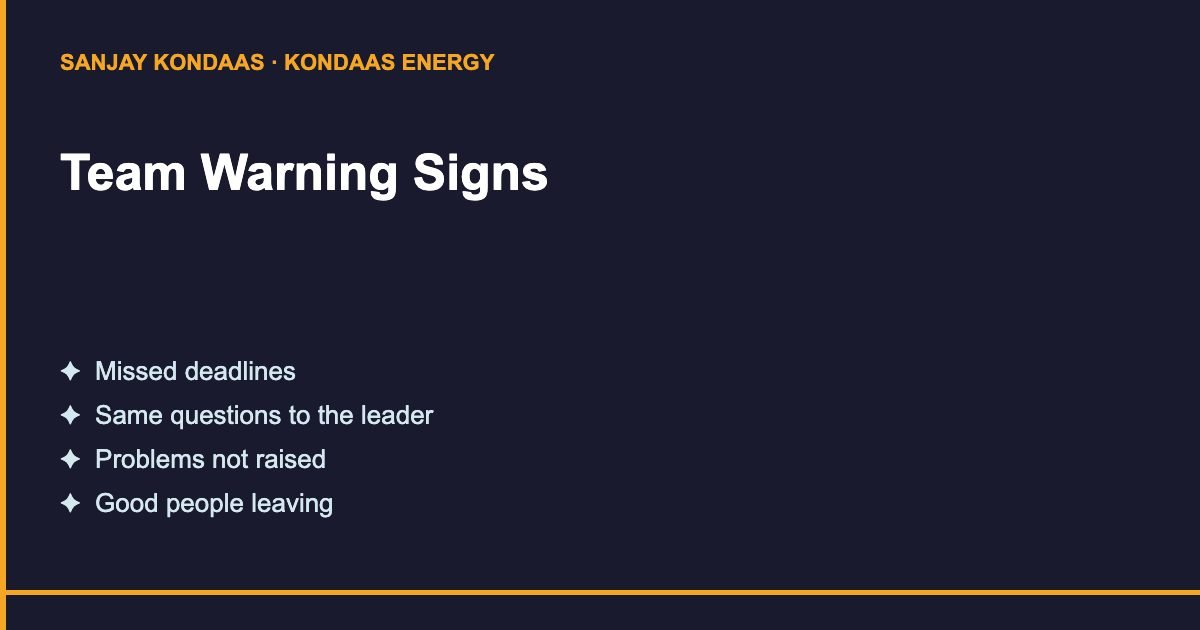
- Deadlines are often missed without clear reasons.
- The same questions keep coming to the leader.
- People avoid raising problems in meetings.
- Good performers are leaving.
FAQs: How to Build a Great Team
What is the most important quality of a great team? Trust — it allows open communication, honest feedback and real collaboration.
How long does it take to build a great team? Months to years. It is an ongoing process of hiring, developing and aligning people.
What should a leader do first? Clarify the team’s purpose and each person’s role, then build regular rhythms for communication.