This MNRE solar subsidy 2026 guide explains how much central financial assistance Tamil Nadu and Kerala homeowners can receive for rooftop solar, who is eligible and how to apply step by step.
Table of Contents
Introduction
Installing a rooftop solar system has become a wise investment for households due to the rising electricity costs and the growing need for renewable energy. The Ministry of New and Renewable Energy (MNRE) continues to offer attractive subsidy schemes for residential rooftop solar installations to promote the adoption of renewable energy.
Homeowners who qualify can install rooftop solar systems and receive up to₹78,000 in MNRE solar subsidies under the PM Surya Ghar: Muft Bijli Yojana. Understanding the most recent MNRE Solar Subsidy 2026 criteria will help homeowners in Kerala or Tamil Nadu save money on power bills over time while lowering installation expenses. This guide will teach you about benefits, eligibility for subsidies, how to apply, and how to get the most out of your funds.
The MNRE Solar Subsidy: What is it?
The Indian government offers a financial incentive called the MNRE Solar Subsidy to promote residential rooftop solar systems. The subsidy lowers the initial cost of solar panel installation, making renewable energy more accessible to homeowners.
The PM Surya Ghar:
Muft Bijli Yojana, which encourages the use of clean energy and seeks to expand rooftop solar installations throughout India, is the main program that offers the subsidy.
The MNRE Solar Subsidy 2026’s advantages
There are a number of benefits to installing a rooftop solar system with government funding.
Considerable Installation Cost Reduction
More people can now afford solar energy thanks to the MNRE subsidy, which reduces the initial outlay needed to build a rooftop solar system.
Reduced Power Costs
Protect yourself from escalating electricity rates by producing your own electricity, which will drastically lower your monthly power expenses.
Quicker Return on Investment
Through lower electricity bills, government financial aid enables homeowners to recoup their investment considerably more quickly.
Sustainable and Clean Energy
Solar energy minimizes your home’s carbon impact and your reliance on fossil fuels.
A rise in the value of properties
Due to their reduced operating costs and increased energy efficiency, homes with rooftop solar systems frequently fetch better resale values.
Homeowners in both states can drastically reduce their rooftop installation costs by claiming up to ₹78,000 under the PM Surya Ghar Muft Bijli Yojana byfollowing the MNRE solar subsidy 2026 Tamil Nadu Kerala rules.
The MNRE Solar Subsidy is available to whom?
Make sure you are eligible before submitting an application.
Owners of Residential Property
Only residential rooftop solar systems installed on individual dwellings are eligible for the incentive.
Citizens of India
Candidates must reside in India and have a current power connection registered in their name.
Authorized Solar Providers
To be eligible for the subsidy, the installation must be carried out by a government-approved or MNRE-empanelled solar vendor.
Grid-Linked Solar System for Rooftops
The program only applies to residential rooftop solar installations that are on-grid.
Kerala residents can receive up to ₹78,000 directly into their bank accounts for residential rooftop installations by applyingfor the KSEB solar subsidy 2026 under the PM Surya Ghar scheme.
Amount of MNRE Solar Subsidy for 2026
The installed system capacity and current government regulations determine the amount of the subsidy.
Rooftop Solar Capacity Estimated Residential Subsidy *
As much as 2 kWA maximum of ₹30,000 per kW
Extra capacity (up to a total of 3 kW): Up to ₹18,000 for every extra kW
The maximum residential subsidy is ₹78,000.
Note: The most recent MNRE and PM Surya Ghar standards apply to subsidy amounts. Prior to installation, always confirm the current rates.
When building a subsidized rooftop system under the PM Surya Ghar plan, homeowners can determine their precise out-of pocket costs by knowing the net DCR solar panel cost after subsidy 2026.
How to Apply for Kerala and Tamil Nadu’s MNRE Solar Subsidy
The process of applying for the subsidy is simple. Sign up on the official website. Using your power customer information, register for an account on the official PM Surya Ghar rooftop solar portal.
Select a Solar Vendor with Approval
To guarantee your eligibility for a subsidy, choose a solar installer who is empanelled and authorized. Set up the solar system on your roof. The installation will be conducted in accordance with MNRE technical standards by the authorized installer.
Examination and Net Metering
Following installation, net metering is approved by your local power distribution company (DISCOM) following an inspection.
Obtain a Subsidy
The authorized subsidy amount is sent straight to your registered bank account after verification is finished.
Documents Needed for the MNRE Solar Subsidy
Before applying, make sure you have the necessary paperwork ready.
Verification of Identity Aadhaar Card
PAN Card (if relevant)
Proof of Address
Proof of residential address
Bill for Electricity
Most recent power bill
Customer number and bank account information
Aadhaar-linked bank account
Cancelled passbook or check copy
Documents Concerning Property Ownership
Evidence proving your ownership of the home where the solar system will be installed.
Why Keralan and Tamil Nadu Homeowners Should Apply
Rooftop solar is quite effective in Tamil Nadu and Kerala because of their year-round great solar irradiation.
High Potential for Solar Energy
Homeowners can produce significant amounts of electricity all year long when there is plenty of sunshine.
Growing Electricity Prices
Solar panels offer long-term cost savings and less reliance on the grid for electricity.
Government Assistance
Solar installation is now more affordable than ever thanks to MNRE subsidies and state-level renewable energy initiatives.
Living Eco-Friendly
Making the switch to solar energy helps create a brighter future for future generations and healthier air.
Typical Errors to Avoid When Selecting Unapproved Vendors
You may not be eligible for the subsidy if you install solar panels using unapproved vendors.
Inaccurate Records
Documents that are erroneous or incomplete may cause a delay in approval.
Installing Prior to Enrollment
To prevent issues, always adhere to the approved subsidy procedure prior to installation.
Disregarding System Quality
Selecting subpar parts could lower energy production and long-term savings.
MNRE Solar Subsidy for Various Independent Homeowners
Ideal for raising property values and lowering household electricity costs.
Residents of Apartments
Subject to scheme criteria, eligible apartment associations may receive benefits under relevant government regulations.
Households in Rural Areas
For rural families looking for dependable electricity, government subsidies make solar power more affordable.
Homeowners in cities
Lessen reliance on the electrical grid while promoting sustainable urban growth.
Conclusion
Homeowners in Kerala and Tamil Nadu have a great chance to transition to clean, renewable energy at a much lower cost because to the MNRE Solar Subsidy 2026.
The PM Surya Ghar:
Muft Bijli Yojana offers subsidies of up to ₹78,000, making rooftop solar system installation more accessible than ever. You can benefit from lower electricity costs, longterm financial savings, greater energy independence, and a smaller carbon footprint by selecting an authorized solar installer, accurately completing the application procedure, and investing in a highquality rooftop solar system. Now is the perfect time to take advantage of government funding and create a more sustainable future if you intend to install rooftop solar in 2026.
In Kerala and Tamil Nadu, switching to rooftop solar has never been more financially appealing. Homeowners in both states can significantly reduce monthly power bills and offset a large portion of initial installation costs with the MNRE PM Surya Ghar initiative, which offers up to ₹78,000 in direct bank subsidies for 3 kW systems.
Frequently Asked Question
1. What is the maximum MNRE solar subsidy available in 2026?
Eligible residential homeowners can receive up to ₹78,000 under the PM Surya Ghar: Muft Bijli Yojana, subject to the latest government guidelines.
2. Who is eligible for the MNRE solar subsidy in Tamil Nadu and Kerala?
The subsidy is available to residential homeowners installing approved on-grid rooftop solar systems through empanelled vendors.

MNRE Solar Subsidy 2026 by System Size
Under the PM Surya Ghar: Muft Bijli Yojana, central financial assistance for eligible residential rooftop systems is linked to system capacity. As a guide:
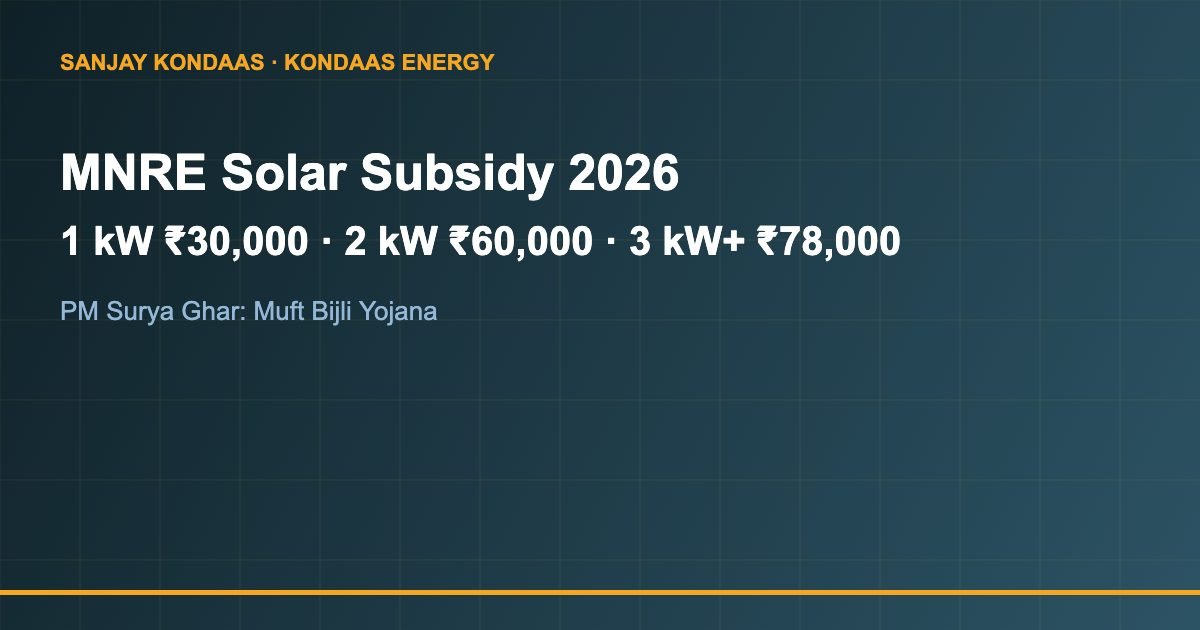
- 1 kW system: up to ₹30,000 (₹30,000 per kW up to 2 kW)
- 2 kW system: up to ₹60,000
- 3 kW and above: up to ₹78,000 (₹18,000 for the additional kW up to 3 kW; total capped at ₹78,000)
Always confirm the current amounts on the official PM Surya Ghar portal before applying, as scheme details can be revised.
What Size System Should You Choose?
The national portal suggests a simple guide based on average monthly electricity consumption: 0–150 units — 1–2 kW; 150–300 units — 2–3 kW; above 300 units — above 3 kW. As per the portal, the scheme is open until 31 March 2027, so eligible households should plan their applications in good time.
7 Proven Steps to Claim the MNRE Solar Subsidy
Step 1: Register on the National Portal
Create an account on the PM Surya Ghar portal by selecting your state (Tamil Nadu or Kerala), your electricity distribution company and your consumer number.
Step 2: Apply for Rooftop Solar
Log in and submit the rooftop solar application form with your details. The portal forwards it to your distribution company for a feasibility check.
Step 3: Get Feasibility Approval
Once your DISCOM (TNPDCL in Tamil Nadu or KSEB in Kerala) approves feasibility, you can proceed with installation.
Step 4: Choose a Registered Vendor
Install your system through a vendor registered with your DISCOM. The panels used must meet the scheme’s domestic content and ALMM requirements.
Step 5: Install and Submit Plant Details
After installation, submit the plant details on the portal and apply for net metering.
Step 6: Net Meter Installation and Inspection
The DISCOM installs the net meter and inspects the system. After a successful inspection, a commissioning certificate is generated on the portal.
Step 7: Submit Bank Details and Receive the Subsidy
Submit your bank account details and a cancelled cheque through the portal. The MNRE solar subsidy is then credited directly to your account.
Who Is Eligible for the MNRE Solar Subsidy 2026?
- Indian citizens who own a house with a suitable roof for solar panels.
- A valid electricity connection in the applicant’s name.
- The household should not have availed any other central subsidy for rooftop solar.
- A grid-connected system installed through a registered vendor using eligible components.
Documents You Will Typically Need
- Recent electricity bill
- Identity and address proof
- Proof of property ownership
- Bank account details and cancelled cheque
- Photographs of the roof and installed system, as requested
Common Mistakes to Avoid
Using non-DCR panels, choosing an unregistered vendor or skipping net-metering steps can delay or disqualify your MNRE solar subsidy claim. Work with an experienced installer who knows the Tamil Nadu and Kerala processes. Read our guides on DCR rooftop solar and ALMM rules, TNEB vs KSEB net metering and rooftop solar myths.
FAQs on the MNRE Solar Subsidy 2026
How much is the MNRE solar subsidy for a 3 kW system? Eligible households can receive up to ₹78,000 for systems of 3 kW and above.
Is the subsidy available in both Tamil Nadu and Kerala? Yes. PM Surya Ghar is a national scheme, and residents of both states can apply through the national portal.
Can I get the subsidy for an off-grid system? The residential rooftop scheme is for grid-connected systems with net metering.
Who can help me apply? Kondaas, founded by Sanjay Kondaas in Coimbatore, helps eligible customers across Tamil Nadu and Kerala with system design, installation and subsidy steps.
4 thoughts on “Claim Up to ₹78,000! MNRE Solar Subsidy 2026 Guide for Tamil Nadu & Kerala”