What’s in this article
What leadership lessons come from training 49,000 schoolkids?
Between 2003 and 2011, alongside building Kondaas from the ground up, I spent a large part of those years as a National Level Trainer for Round Table India — standing in front of school classrooms, not boardrooms. By the time that chapter wound down, I’d trained close to 49,000 school children — and picked up leadership lessons I still lean on today.
At the time, it didn’t feel like it had anything to do with the business. Looking back at it now, with Kondaas grown to over 200 people across Tamil Nadu and Kerala, I don’t think that’s true at all.
The part nobody warns you about
Here’s what surprised me early on: a room full of fourteen-year-olds is a brutally honest audience. They don’t perform interest they don’t have. If what you’re saying doesn’t land — if it’s vague, or you’re not being straight with them, or you clearly haven’t thought it through — you find out immediately, not in a delayed performance review six months later.
Running a 200-person company taught me a version of the same lesson, just slower. People don’t tell you when systems aren’t working. They route around them, or they quietly disengage, and you only find out when something breaks. The classroom version of that feedback is instant. The company version takes months to surface — which makes it more dangerous, not less real.
Three leadership lessons that carried over
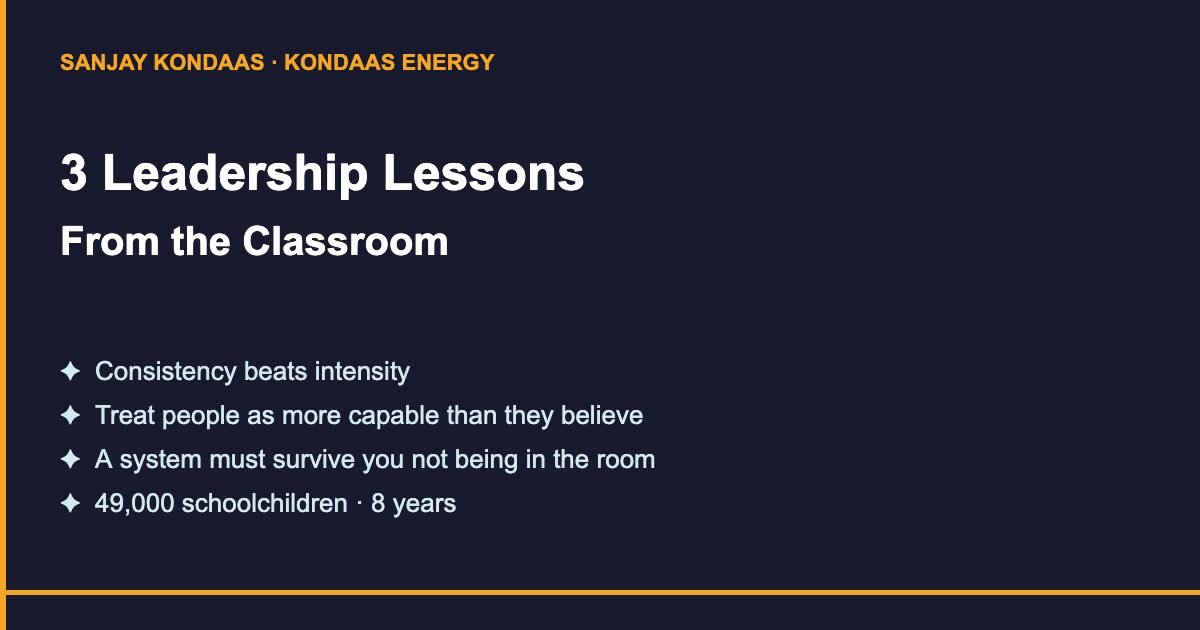
Consistency beats intensity. You can’t win over a room of teenagers with one great session and then show up unprepared the next month — they remember, and they stop trusting you. The same is true of a team. A founder who’s inspiring in a quarterly all-hands and absent the rest of the time doesn’t build trust; a founder who shows up the same way on an ordinary Tuesday does. It’s a belief I’ve carried straight from those classrooms into how I think a company should be led — consistency is the only kind of credibility that actually compounds.
Treat people as more capable than they currently believe. Part of what those Round Table sessions were built around — alongside the National HRD Convener work I did in 2005–06 and again in 2007–08 — was simply refusing to talk down to a room of fifteen-year-olds. Most of them rose to whatever level you assumed they could handle. It turns out grown adults on a payroll aren’t fundamentally different. Underestimate your team and you’ll get exactly the underwhelming performance you expected.
A system only works if it survives you not being in the room. Training thousands of students across hundreds of sessions only works if what you’re teaching doesn’t depend on you personally delivering it forever — eventually other trainers carry it, or it doesn’t scale past whatever a single person can physically show up for. That’s the same test I apply to Kondaas now: if a process only works because I’m personally checking it, it isn’t a system yet, it’s just me deferring the failure.
Why this still shapes how Kondaas is run
I still hold a Learning Chair role at EO Coimbatore, and I’m currently President of CORE — not because it’s good networking, but because staying inside a room where you have to teach something clearly, to people who won’t pretend to understand you if you haven’t explained it well, keeps you honest in a way that running your own company alone doesn’t.
The uncomfortable version of this is: if you can’t explain what you’re building to a room of teenagers in a way that actually holds their attention, you probably haven’t thought it through as clearly as you assume you have. That test has stayed useful for over two decades, long after the classrooms themselves stopped being the point.
The actual takeaway
None of this is a tidy motivational line about “leadership lessons from unexpected places.” It’s simpler and less comfortable than that: the feedback you get from people who have no reason to be polite to you is worth more than the feedback you get from people who work for you. Most founders only get the second kind. I got a decade of the first kind first, and I don’t think Kondaas would run the way it does without it.
Leadership Lessons From the Classroom: Common Questions
What is the most transferable leadership lesson from teaching to running a company?
The single most transferable leadership lesson is this: you cannot manage energy you have not first earned. With schoolchildren, the moment you lose the room’s energy, no amount of authority brings it back. The same is true on a job site or in a board meeting. Leadership lessons from teaching forced me to focus on holding attention through genuine engagement — not through position. That discipline reshaped how I open every Kondaas team meeting.
Do formal leadership lessons — MBAs, management courses — teach what real leadership looks like?
They teach frameworks. They do not teach the moment. One of the leadership lessons I carry from eight years working with children is that textbooks describe what leadership should look like in ideal conditions; children show you what leadership looks like when conditions are never ideal. Every class had a disruptor, a disengaged student, a latecomer, and a child who had not eaten. Those are the conditions in which real leadership lessons are learned — not case studies.
How do leadership lessons from working with children apply to a 200-person company?
Scale changes numbers, not principles. When you lead 200 people, you are still — at some level — managing 200 individuals with different energy levels, different home situations, and different definitions of a good day. The leadership lessons that stayed with me are about reading the room fast, adjusting your approach without losing your objective, and making people feel seen before you ask them to perform. These are not soft skills — they are the hardest, most precise skills in any organisation.
What leadership lesson surprised you most from the schoolchildren programme?
That the teacher changes more than the student. You expect to teach leadership lessons. You do not expect to have your own blind spots — impatience, assumption, a tendency to skip explanation — reflected back at you by a nine-year-old who simply stopped listening. The most valuable leadership lessons do not come from the moments things work. They come from the moment a room of children tells you, without words, that you’ve lost them. That feedback loop is brutal and honest in a way corporate feedback never is.
Leadership Lessons in Practice: What I Actually Carry Into Kondaas
These are the leadership lessons from eight years of working with 49,000 children that have direct counterparts in how Kondaas operates today:
- Start with why, not what. Children don’t follow instructions they don’t understand. Neither do good employees. Every briefing at Kondaas starts with context.
- Energy is a resource — manage yours first. A leader who walks in depleted will deplete the room. This is a leadership lesson that every high-output work environment eventually teaches you.
- Repetition is not failure. Teaching the same concept forty different ways to reach forty different learners taught me that clarity is not about your delivery — it is about the receiver’s understanding. Repeating a message differently is leadership, not incompetence.
- Attention precedes action. Before you can lead anyone, you have to earn their attention. No leadership lesson I have read explains this better than a classroom of thirty-two children deciding, in the first thirty seconds, whether you deserve theirs.
- Consistency is the only real currency. Children remember what you did last time. So does your team. Consistency in standards and behaviour is not a management technique — it is the foundation of trust, and it is the deepest leadership lesson the classroom taught me.
Leadership Lessons: Classroom vs. Boardroom — Side by Side
| Situation in the Classroom | Direct Leadership Lesson for Business |
|---|---|
| A student stops listening mid-session | Your message lost relevance — change the angle, not the volume |
| One child’s energy disrupts thirty others | One disengaged team member costs more than their own output |
| The same concept needs explaining four different ways | Communication is the receiver’s job to understand, not just the sender’s job to say |
| Children remember your mood more than your words | Teams absorb the leader’s state — walk in grounded, not reactive |
| Consistency across sessions builds safety | Predictable standards create psychological safety — the foundation of high performance |
| Praise in public, correct in private | The same principle works at every level of a 200-person hierarchy |
These leadership lessons did not come from a workshop. They came from eight years of standing in front of children who had no obligation to pretend they were engaged. That kind of feedback — instant, unfiltered, and honest — is one of the rarest inputs a leader ever gets.
If you’re building something and want to talk systems, leadership lessons, or where solar and entrepreneurship intersect — reach out directly.
2 thoughts on “What Eight Years of Training 49,000 Schoolchildren Taught Me About Running a 200-Person Company”