Deciding between rooftop vs ground-mounted solar affects your costs, generation and long-term maintenance. This guide compares both options side by side.
Table of Contents
Introduction
Homeowners, companies, and industries seeking to use clean energy and reduce on electricity costs are increasingly turning to solar energy. But picking the best solar panel installation involves more than just picking the panels or inverter. Choosing whether to place the system on the ground or on a rooftop is one of the most crucial choices.
Both ground-mounted and rooftop solar systems can produce clean electricity and lessen reliance on the grid. The best choice, however, may depend on a number of criteria, including available space, installation costs, roof condition, solar exposure, maintenance needs, and future energy requirements.
We will contrast rooftop and ground-mounted solar systems, discuss their benefits and drawbacks, and assist businesses and homeowners in choosing which solar installation is the best option for their needs.
A Rooftop Solar System: What Is It?
Photovoltaic panels installed on the roof of a residential, commercial, or industrial structure constitute a rooftop solar system.
Sunlight is captured by the panels and transformed into DC electricity. The electricity is then transformed into AC power by a solar converter so that appliances and other electrical devices can use it.
Properties with adequate roof area and good sunlight exposure are best suited for rooftop solar.
The Operation of Rooftop Solar
The fundamental procedure is:
Sunlight is absorbed by solar panels. DC electricity is produced by photovoltaic cells. DC electricity is transformed into AC electricity by a solar inverter.
The building’s electrical system receives the electricity. In grid-connected systems that qualify, excess electricity can be exported to the grid. Understanding the main differences in rooftop vs ground-mounted solar helps you pick the right system for your property and energy goals.
A Ground-Mounted Solar System: What Is It?
Rather than being mounted on a building’s roof, a ground-mounted solar system is erected on a special structure that is attached to the ground.
When there is enough open space, ground-mounted systems are frequently utilized for big residential properties, farms, commercial buildings, enterprises, universities, and solar projects.
The panels can be positioned and configured to achieve optimum solar exposure while giving easy access for inspection and maintenance.
Key Distinctions Between Ground-Mounted and Rooftop Solar
Although both systems employ the same fundamental photovoltaic technology, there are differences in the installation requirements.
Location of Installation
Rooftop solar:
An existing roof is fitted with panels.
Ground-mounted solar:
Panels are erected on a dedicated structure on available ground.
Ground-mounted solar panels maximize daily sunshine exposure and energy output by enabling ideal placement and tilt angles.
Benefits of Rooftop Solar Systems: Utilizes Available Space
The fact that rooftop solar utilizes existing roof space instead of needing new land is one of its main advantages.
Ideal for Urban Properties
Rooftop solar installation can be advantageous for homes and businesses in places where land is expensive or scarce.
Aids in Lowering Energy Costs
Reducing reliance on grid electricity and possibly lowering monthly electricity costs are two benefits of producing electricity at the point of consumption.
Prevents Certain Weather Exposure
While keeping the panels above ground-level obstructions, a well-designed rooftop installation can blend in with the structure.
Ideal for Residences and Companies
Depending on the suitability of the site, rooftop solar can be installed on homes, workplaces, schools, warehouses, factories, and commercial structures.
Rooftop Solar’s Drawbacks
Roof Condition Is Important
Before solar panels may be put, a roof that is outdated or structurally unsuitable may need to be strengthened or repaired.
Restricted Installation Space
The quantity and configuration of solar panels may be limited by the roof’s size and form.
Shading May Lower Generation
Shadows cast by trees, parapets, adjacent buildings, water tanks, and other rooftop features can reduce the amount of solar energy produced.
Upkeep May Be More Challenging
Rooftop panel access may need the right safety gear and workers with the necessary training.
Benefits of Ground-Mounted Solar Systems: Increased Design Flexibility
When there is enough land available, ground-mounted solar systems can offer greater flexibility in panel orientation, spacing, and configuration.
Simple Maintenance Access
Ground-mounted panels are typically easier for technicians to access, which makes maintenance, cleaning, and inspection more convenient.
Common Myths Regarding Ground-Mounted and Rooftop Solar
Myth 1: More Power Is Always Produced by Ground-Mounted Solar
Fact: Whether the panels are installed on the ground or on the roof is not the only factor that affects energy output; additional factors include system design, sunshine, shading, panel orientation, and other operational variables.
Myth 2: Only Homes Can Use Rooftop Solar
Fact: If the roof is appropriate, rooftop systems can also be installed on commercial, institutional, and industrial buildings.
Myth 3: The Cost of Ground-Mounted Solar Is Always Higher
Fact: System size, site preparation, mounting structures, civil work, and installation requirements all affect costs.
Myth 4: A Lot of Land Is Needed for Solar Panels
Fact: Rooftop systems are helpful in areas with limited land since they may produce electricity utilizing existing building space.
Which Is Better, Rooftop or Ground-Mounted Solar?
No single solution is suitable for all properties.
Select rooftop solar power when:
There is plenty of useful area on your roof.
The roof is structurally sound.
You don’t want to use more land.
There is plenty of solar exposure on your land.
You require a workable solution for the use of power in homes or businesses.
Think about installing solar on the ground when:
You have plenty of open space.
There is not much useful area on your roof.
Solar installation is not appropriate for the roof.
You need a bigger solar system.
For maintenance, easy access is crucial.
Expanding the system in the future is important.
The best choice can be found with the assistance of a professional solar site evaluation.
Rooftop solar panels provide a practical, compact way to produce dependable solar energy directly from your house.
Conclusion
Your property’s available space, roof condition, energy needs, budget, sunlight exposure, and future plans all play a role in the decision between rooftop and ground-mounted solar.
Rooftop solar is frequently a sensible choice for residences and commercial buildings and makes great use of the existing building space. When appropriate land is available, ground-mounted solar offers more flexibility and can be especially helpful for larger projects.
Both choices can lessen reliance on traditional electricity, cut long-term energy costs, and facilitate the switch to renewable energy. Choose a professionally built solar power system that offers the most long-term value by considering your site and electricity requirements rather than just the type of installation.
Are You Prepared to Change?
You can achieve energy independence and long-term utility savings by either using your roof or making room on the ground. A competent site survey to determine shading, structural readiness, and local restrictions is essential to making the best decision.
Take the next step in your clean energy journey by getting the proper setup installed and speaking with a solar professional right now!
Frequently Asked Question
1. Is rooftop solar better than ground-mounted solar?
Neither option is universally better. Rooftop solar is generally convenient where suitable roof space is available, while ground-mounted solar can be advantageous when sufficient open land is available.
2. Does ground-mounted solar produce more electricity?
Not necessarily. Electricity generation depends on factors such as sunlight, shading, panel orientation, tilt, system design, and panel technology.
Rooftop vs Ground-Mounted Solar: 7 Essential Differences
1. Space Requirements
Rooftop solar uses space you already have, which makes it ideal for homes and city buildings. Ground-mounted solar needs open land free from shade, making it better suited to farms, factories and institutions with spare land.
2. Installation Cost
Rooftop systems usually cost less per kilowatt because the building provides the base. Ground-mounted solar needs foundations, taller structures and sometimes fencing, which add to the cost.
3. Orientation and Tilt
On a roof, panels must follow the roof’s direction and slope. Ground-mounted systems can be installed at the ideal angle and orientation, and can even use tracking structures, which can improve generation.
4. Cooling and Performance
Panels perform better when they stay cooler. Ground-mounted systems often have more airflow underneath, while rooftop systems need proper mounting height to avoid heat build-up.
5. Maintenance Access
Ground-mounted panels are easy to reach for cleaning and inspection. Rooftop systems need safe access such as walkways and railings, especially on sloped or high roofs.
6. Scalability
Rooftop capacity is limited by roof area. Ground-mounted solar can be expanded as long as land is available, making it attractive for growing businesses.
7. Approvals and Subsidies
Residential rooftop systems may qualify for central financial assistance under PM Surya Ghar, subject to eligibility. Ground-mounted and commercial projects follow different rules, so check applicable schemes and net-metering regulations before deciding.
Which Should You Choose?
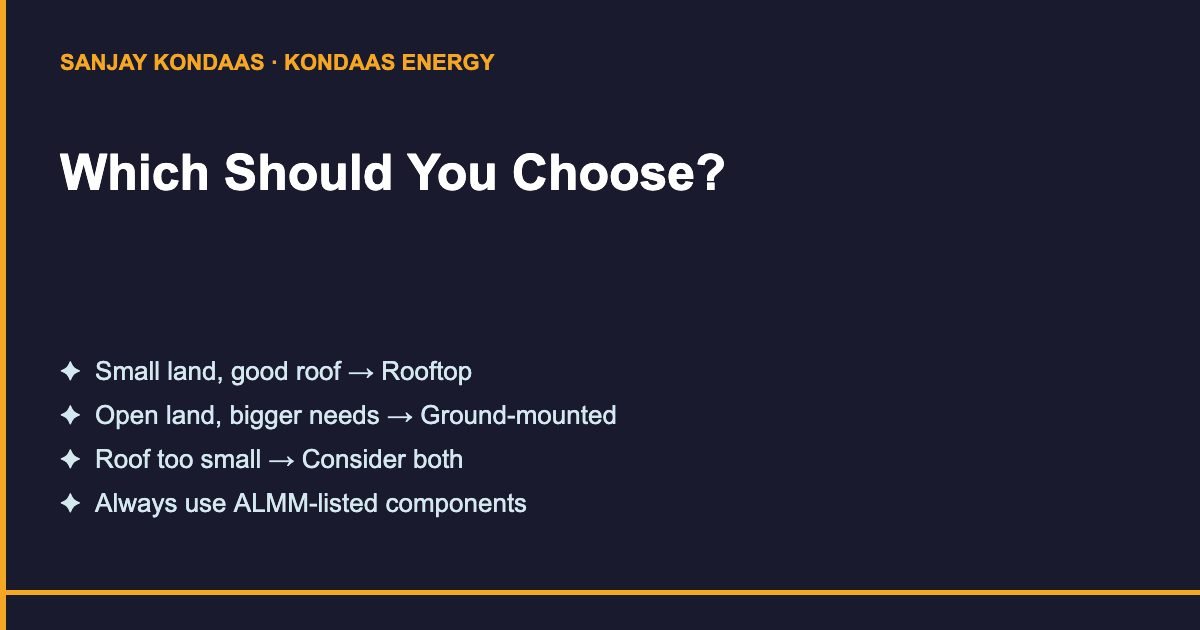
- Choose rooftop solar if you have a strong, shade-free roof, limited land and want the lowest cost per kW.
- Choose ground-mounted solar if you have open land, need a larger system or want the best orientation and easy maintenance.
- Consider both if your roof is too small for your energy needs but you also have some usable land.
Whichever you choose, use ALMM-listed components and a qualified installer. Subsidy details for homes are available on the PM Surya Ghar portal. Related guides: string inverter vs hybrid inverter, 5 costly solar system failures and rooftop solar myths.
FAQs: Rooftop vs Ground-Mounted Solar
Which produces more power, rooftop or ground-mounted solar? Ground-mounted systems can produce more per panel because they can be set at the ideal angle, but a well-designed rooftop system also performs very well.
Is ground-mounted solar more expensive? Usually yes, due to foundations and structures, though it may offer better generation and easier maintenance.
Can I get a subsidy for ground-mounted solar at home? Residential subsidy schemes are generally focused on rooftop systems; check current scheme rules before planning.
Who can help me decide in Tamil Nadu or Kerala? Kondaas, founded by Sanjay Kondaas in Coimbatore, designs both rooftop and ground-mounted systems.