Choosing between a string inverter vs hybrid inverter is one of the most important decisions in a rooftop solar project. This guide explains the differences in plain language so you can match the inverter to your budget and backup needs.
Table of Contents
Introduction
Which Solar Inverter Should You Choose?
If you don’t require a battery backup, have no power outages, and want the cheapest option, go with a standard string inverter. If you need energy storage, want a future proof system, and want battery backup during power outages, go with the Smart Deye Hybrid Inverter. DC electricity from solar panels is transformed into AC power for your house by solar inverters. The two most prevalent kinds of residences and commercial buildings in Coimbatore in 2026 are:
1. Conventional String Inverter
Easy, grid-tied, and reasonably priced
2. Smart Deye Hybrid Inverter
Backup power, battery-ready, and intelligent energy management
This tutorial compares and contrasts String and Deye hybrid inverters based on features, cost, and which is better for houses in Tamil Nadu.
What Makes Solar Inverters Vital?
An essential part of a solar power system is a solar inverter. Most home and business appliances run on alternating current (AC), whereas solar panels provide direct current (DC) electricity. The solar panels’ electricity is transformed into usable AC power by the inverter.
Additional features that modern solar inverters can offer include battery management, grid interface, system monitoring, and energy optimization. Therefore, selecting the appropriate inverter can enhance your solar power system’s overall performance, dependability, and adaptability.
When comparing a string inverter vs hybrid inverter, future-proof battery readiness is more important than reduced initial expenses.
A Standard String Inverter: What Is It?
Several solar panels are connected in a string, or series, by a standard string inverter. A central inverter receives the DC electricity produced by these panels and transforms it into AC electricity for use within the building or export to the grid. Because string inverters provide a somewhat easy and affordable option, they are frequently utilized in both residential andcommercial solar installations.
Important Characteristics of Conventional String Inverters
Easy and dependable system architecture. Many home and business setups can use it. Economical in comparison to more sophisticated inverter systems. Simple installation and upkeep; effective performance when panels are exposed to comparable levelsof sunlight. Ideal for solar systems that are connected to the grid.
However, when one or more panels are shaded, dirty, or receive less sunshine, a string inverter’s performance may be impacted. Variations in panel performance may have an impact on the output of the connected string because panels are connected in strings.
Solar inverters simplified: discover the key distinctions between battery-ready hybrid setups and conventional string systems in simple terms.
A Smart Deye Hybrid Inverter: What Is It?
A Smart Deye Hybrid Inverter is an intelligent system that integrates battery storage, grid electricity, and solar power generation. Because of this, consumers who wish to have more control over the production, storage, and use of their electricity will find it especially helpful.
In addition to managing energy from solar panels and batteries, a Deye Hybrid Inverter can communicate with the electrical grid. Excess solar energy can be stored in batteries and used at a later time when solar generation is low, depending on how the system is configured.
Management of Energy
Simple solar-to-grid or solar-to-load energy conversion is provided by standard string inverters.
By combining solar power, battery charging and discharging, grid electricity, and family or business demands, Smart Deye Hybrid Inverters offer more sophisticated energy management.
Expense
For users that simply need grid-connected solar power, standard string inverters can be more cost-effective and typically have a simpler system configuration.
Due to the possibility of battery storage and other system components, a Deye Hybrid system may require a larger initial expenditure. It does, however, provide more energy-management options and flexibility.
Advantages of Selecting the Appropriate Solar Inverter
Your solar power system might profit from choosing the right solar inverter in a number of ways.
Improved Use of Energy
Which Solar Inverter Is Best for You?
Depending on your energy needs, you can choose between a Smart Deye Hybrid Inverter and a Standard String Inverter.
A standard string inverter might be appropriate if
Your main goal is to have a solar system that is connected to the grid.
At this time, battery storage is not necessary.
You want to set up your system more simply.
The exposure of your solar installation to sunlight is rather consistent.
You’re looking for an affordable solar inverter.
It might be appropriate to use a Smart Deye Hybrid Inverter if
Battery storage should be incorporated.
For some loads, you need backup power.
You want more control over how much energy you use.
Optimizing solar self-consumption is your goal.
In order to meet future needs, you are designing a flexible solar energy system.
Solar Inverter Installation in Coimbatore
Skilled solar specialists can help determine how much electricity you use, suggest an appropriate inverter capacity, and set up the system to meet your energy needs.
Why Opt for Smart Deye Hybrid Inverters?
Hybrid solar systems are becoming a popular choice for contemporary homes and businesses due to the growing use of battery storage and intelligent energy management.
Users of a Smart Deye Hybrid Inverter can benefit from:
Utilize solar-powered electricity more effectively.
Extra solar energy can be stored in batteries that are compatible.
Decrease reliance on electricity from the grid.
Effectively manage several energy sources.
When the system is set up correctly, get backup power.
Construct a renewable energy system that is more adaptable.
Your home will have continuous backup power and smooth battery management during grid disruptions if you upgrade to asmart hybrid inverter Deye model.
Conclusion
Smart Deye Hybrid Inverters and Standard String Inverters are both crucial components of contemporary solar power systems. For simple grid-connected solar installations, a Standard String Inverter may be a good option, but a Smart Deye Hybrid Inverter provides more flexibility through intelligent energy management, backup capabilities, and battery connection.
Think about your electricity usage, solar panel capacity, battery needs, budget, backup needs, and future energy plans before selecting a solar inverter. You can maximize solar energy and transition to a more sustainable and efficient power solution with the correct inverter and expert installation.
Whether you require dependable backup power during blackouts is the primary factor in selecting between a smart Deye hybrid inverter and a traditional string inverter.
Choose a Standard String Inverter if: You want an affordable solution with fewer upfront expenses; your primary objective is to reduce daytime electricity expenditures; and your local power system is dependable.
If you wish to store extra solar energy in batteries for usage at nite, have regular power outages, and want a future-proof configuration that offers complete energy independence, you should choose a Smart Deye Hybrid Inverter.
Frequently Asked Question
1. Can I start with a Deye hybrid inverter now and buy batteries later?
Yes. Deye hybrid inverters can function without a battery installed initially. You can run it like a standard grid-tied inverter today and add battery storage whenever your budget allows.
2. Will a standard string inverter work during a power outage?
No. For safety reasons, standard string inverters automatically shut down during grid power cuts (an anti-islanding feature to protect the utility line and workers). If the main grid goes down, your home loses power even if it is sunny outside.
String Inverter vs Hybrid Inverter: 7 Key Differences
Both inverters convert DC power from solar panels into AC power for your home. The difference lies in what else they can do. Here is a side-by-side look at the seven factors that matter most when comparing a string inverter vs hybrid inverter.
1. Battery Support
A standard string inverter is designed for grid-tied systems without batteries. A hybrid inverter includes a battery charger and management functions, so it can store surplus solar energy in a battery for use later in the day or during outages.
2. Backup During Power Cuts
For safety, a grid-tied string inverter shuts down when grid power fails, even if the sun is shining. A hybrid inverter with a battery can keep selected loads running during a power cut, which is valuable in areas with frequent outages.
3. Upfront Cost
A string inverter usually costs less, making it the budget choice for homes that simply want lower electricity bills. A hybrid inverter costs more, and adding batteries increases the investment further. The right choice depends on how much backup is worth to you.
4. Energy Management
A hybrid inverter can decide when to use solar power, when to charge the battery and when to draw from the grid. Many smart hybrid models, including Deye hybrid inverters, offer app-based monitoring so you can see generation, consumption and battery status.
5. Future Expansion
If you plan to add batteries later, a hybrid inverter makes that upgrade simpler. With a string inverter, adding storage later often requires extra equipment or a replacement inverter.
6. Net Metering
Both inverter types can work with net metering in Tamil Nadu and Kerala, exporting surplus power to the grid. With a hybrid system, you can choose to store more energy rather than export it, depending on your tariff and credit rules.
7. Best Fit
A string inverter suits homes and businesses with reliable grid power that want the lowest cost per unit of solar energy. A hybrid inverter suits customers who face regular outages, want backup for essential loads or plan to add storage in the future.
Quick Decision Guide: String Inverter vs Hybrid Inverter
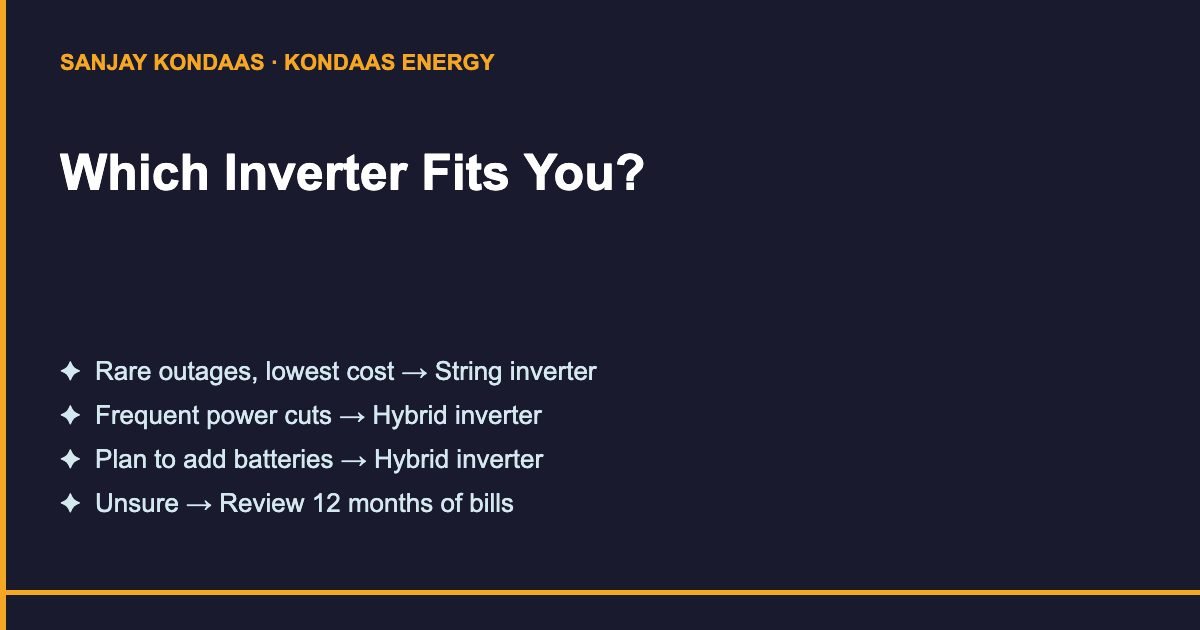
- Choose a string inverter if power cuts are rare, you want the lowest upfront cost and you do not plan to add batteries.
- Choose a hybrid inverter if outages affect your home or business, you want backup for fridges, lights, Wi-Fi or computers, or you want a future-ready system.
- Not sure? Review your last twelve months of bills and outage history with an installer before deciding.
Battery storage is becoming more common in India’s rooftop solar market, supported by national programmes from the Ministry of New and Renewable Energy. To understand why standard on-grid systems switch off during outages, and how subsidies apply, see our guides on the MNRE solar subsidy and TNEB vs KSEB net metering.
Get Expert Advice in Coimbatore
Kondaas Energy, founded by Sanjay Kondaas, designs both on-grid and hybrid solar systems for homes and businesses across Tamil Nadu and Kerala. Through Aurvo Energy, the group also offers LiFePO4 battery storage for customers who need backup.
FAQs: String Inverter vs Hybrid Inverter
Can a string inverter work during a power cut? No. A grid-tied string inverter switches off during outages for safety reasons.
Is a hybrid inverter worth the extra cost? It is worth it if you face frequent power cuts or plan to add batteries. If your grid is reliable, a string inverter often gives a faster payback.
Can I add a battery to a string inverter later? It is possible with additional equipment, but a hybrid inverter makes adding storage much simpler.
Which is better for net metering? Both work with net metering. A hybrid inverter adds the option to store energy instead of exporting it.
5 thoughts on “Solar Inverters Simplified: Standard String vs. Smart Deye Hybrid”