South India solar growth has made the region one of the most important engines of India’s clean energy transition, with the southern states among the country’s renewable energy leaders.
Table of Contents
Introduction
Success in life is the outcome of drive and goal-setting, not something that just happens. Having a clear vision and putting in consistent effort is crucial whether your goal is to lead an industry, build a successful business, or make an impact.
This is most evident in the rapidly expanding solar energy sector in South India. Cities like Coimbatore are becoming centers for solar power solutions in India because of entrepreneurs like Sanjay Kondaas, who are spearheading a new wave of innovation.
In this blog, we examine how goal-setting and motivation relate to South India’s emergence as the center of India’s national solar empire, as well as useful tactics for success and staying on course.
Through his visionary Sanjay Kondaas Solar Leadership, the “Sun King of Kovai” has transformed a local startup into the National Solar Empire, directing the industry toward a 25-year victory Solar Strategy by enforcing DCR-compliant excellence and ALMM List-II technology long before the June 1st deadline.
The foundation of the National Solar Empire is the PM Surya Ghar Muft Bijli Yojana 2026, which offers householders a direct route to a 25year win with a maximum ₹78,000 subsidy and the guarantee of 300 units of free electricity each month.
Motivation: What Is It?
Motivation is what propels people and organizations to act and accomplish their objectives. Both personal aspirations and outside opportunities influence it.
Motivation in the South Indian solar industry often stems from the need to develop sustainable solutions while capitalizing on a rapidly expanding market.
Even the most promising prospects in India’s renewable energy sector may remain untapped without drive.
Motivational Types:
Intrinsic Motivation
Internal motivation is the source of intrinsic motivation. It is motivated by a desire to change the world, passion, and purpose.
For many businesses in Tamil Nadu, the need to use solar energy to achieve a cleaner future is a powerful intrinsic motivator.
Motivation from Without
Profits, recognition, and market expansion are examples of external rewards that impact extrinsic motivation.
One significant external driver is the growing need for solar panel dealers in Coimbatore and throughout South India.
The Value of Setting Goals in Life
Setting goals is crucial for success, particularly in an industry like solar energy that is expanding quickly.
The Advantages of Setting Goals
Provides Purpose and Direction
Businesses in South India’s cutthroat solar sector might grow with well-defined objectives.
Increases Inspiration
Reaching significant goals, such as growing distribution networks, maintains momentum.
Improves Time Management
Timely completion of solar installations is ensured by focused planning.
Promotes Individual Development
Continuous improvement is fueled by market and technology adaptation.
Evaluates Development
Monitoring growth aids in improving tactics and optimizing outcomes.
How to Make Useful Goals
Using the SMART framework is essential for success in India’s renewable energy industry.
SMART Objectives
Particulars:
Increase solar power installations in South India
Measurable:
Expand project capacity and clientele
Achievable:
Develop steadily through solid alliances
Relevant:
Comply with India’s goal of clean energy
Time-bound:
Establish precise due dates for growth
An illustration of a SMART goal
Rather than stating, “I want to grow in solar,” a SMART objective would be:
“Establish a strong presence in the South Indian solar market by building a network of dealers and completing 500 installations within three years.”
Techniques for Maintaining Motivation and Reaching Your Objectives
1. Imagine Your Achievement
Imagine establishing a significant foothold within India’s national solar empire in 2026. Clarity and confidence are produced through visualization.
2. Divide objectives into smaller steps
When a solar business is broken down into smaller, more manageable activities, scaling it becomes easier.
3. Make a Plan and Follow It
In the cutthroat solar industry, steady growth is guaranteed by a well-defined roadmap.
4. Maintain Discipline and Consistency
In Tamil Nadu’s rapidly changing solar energy sector, consistency is essential to success.
5. Get Rid of Procrastination
Making decisions quickly enables one to take advantage of chances in a market that is expanding.
6. Look for Motivation and Assistance
Gaining knowledge from prominent figures in the field, such as Sanjay Kondaas, can be quite beneficial.
- Give Yourself a Reward for Achievements
Celebrate accomplishments like successful installations or company growth.
8. Remain optimistic and learn from mistakes
Although difficulties in the solar industry are unavoidable, they can teach us valuable lessons.
Overcoming Typical Goal-Setting Obstacles
1. A fear of not succeeding
It may seem hazardous to enter the Indian solar power sector, but calculated risks pay off.
2. Insufficient Self-Belief
Building a successful solar venture requires having faith in your vision.
3. Distractions and Inability to Concentrate
In a cutthroat market, having clear priorities makes it easier to stay focused.
4. Establishing Impractical Objectives
Long-term sustainable growth is ensured by balanced goals.
Motivation and Setting Objectives in Various Domains of Life
1. Professional and Career Development
For qualified professionals, the solar business offers a plethora of chances.
2. Entrepreneurship and Business
With its scalable prospects, South India is emerging as a hub for solar entrepreneurs in India.
3. Individual Growth
Long-term success in renewable technology is improved by ongoing learning.
4. Economic Achievement
Strong and long-lasting returns are guaranteed when investing in solar energy.
5. Social Effects
Encouraging solar energy contributes to environmental goals by lowering carbon emissions.
Conclusion
It is no accident that South India has become the center of the country’s solar empire. It is motivated by a clear vision and well-defined objectives. Leaders like Sanjay Kondaas are demonstrating that it is feasible to create successful and expandable businesses with the correct attitude and approach. The ascension of the Sun Kings is the pinnacle of the National Solar Empire, not only a change in infrastructure. South India will formally surpass 10 GW in 2026, marking the region’s transformation from a mere participant to the center of India’s renewable energy revolution.
Policy and enthusiasm must be perfectly aligned for this movement to succeed. Homeowners from Coimbatore to Kochi are now empowered prosumers rather than just customers, thanks to the PM Surya Ghar subsidy and ALMM-Approved Distributors’ high-efficiency N-Type TOPCon technology.
The empire has successfully overcome the issue of energy independence for 25 years under the visionary leadership of Sanjay Kondaas, the Sun King of Kovai. South India is not only steering the country toward a greener future by selecting DCR-compliant modules and TEDA-registered expertise, but it is also setting the benchmark for what a decentralized, solar-powered empire looks like.
Frequently Asked Question
- Why is South India considered the ‘Heart’ of the National Solar Empire?
As of April 2026, South India leads the nation with a 35% share of the total rooftop solar market. With high solar irradiance and progressive policies in states like Tamil Nadu and Kerala, the region has become the primary engine driving India toward its 150 GW solar milestone achieved this quarter.
2. What is the maximum subsidy I can get under the PM Surya Ghar Muft Bijli Yojana Tamil Nadu in 2026?
For residential systems, you can receive a direct Central Financial Assistance (CFA) of up to ₹78,000 for systems of 3 kW and above. This subsidy, combined with the promise of 300 units of free electricity, ensures a “25-year victory” for your household budget.
6 Reasons South India Solar Leads the Way
1. Strong Sunshine Across the Year
Tamil Nadu, Karnataka, Andhra Pradesh and Telangana receive strong solar radiation for much of the year, and even Kerala’s rooftops generate well outside peak monsoon weeks.
2. Landmark Solar Parks
The region hosts some of India’s largest solar installations, such as the Pavagada Solar Park in Karnataka, showing what utility-scale solar can achieve.
3. Industrial Demand
Manufacturing hubs in Coimbatore, Chennai, Bengaluru and Hyderabad need large amounts of daytime electricity — a natural match for solar generation.
4. Rooftop Momentum
With central support under PM Surya Ghar, rooftop solar is spreading rapidly across southern homes, turning households into small power producers.
5. Skilled Workforce
Strong engineering education and a large technical workforce make it easier for solar companies to find and train skilled people.
6. Local Solar Leaders
Regional companies turn national policy into working systems. In Coimbatore, Kondaas — founded by Sanjay Kondaas in 1995 — serves homes and businesses across Tamil Nadu and Kerala, and has trained more than 49,000 schoolchildren in solar awareness.
What South India Solar Growth Means for You
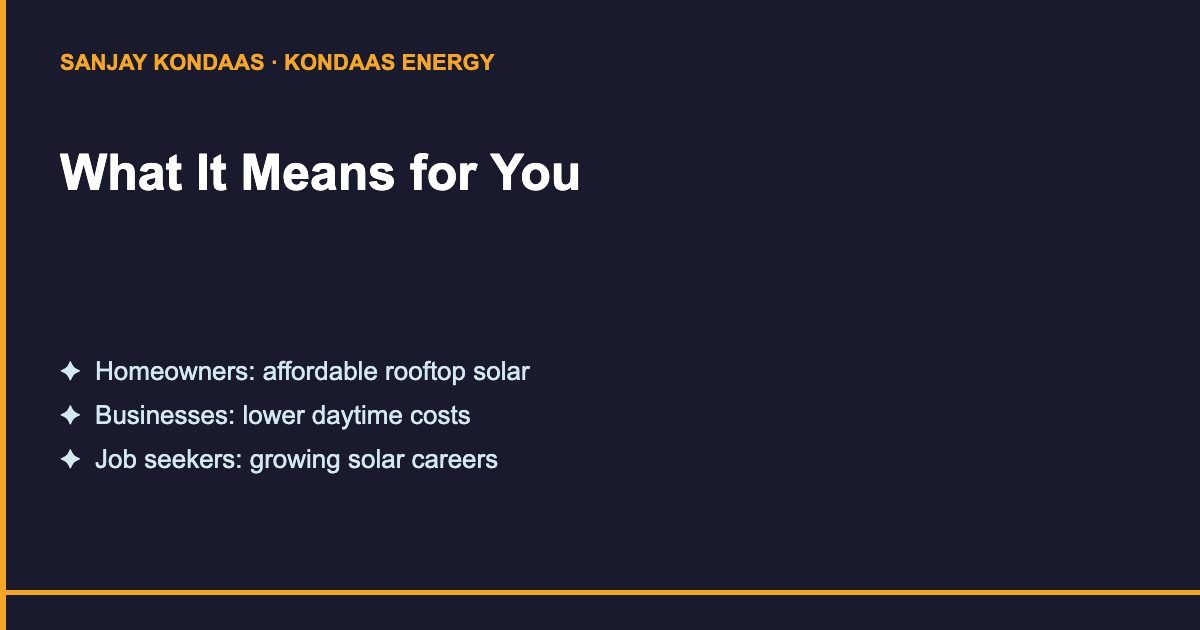
- Homeowners: subsidies and net metering make rooftop solar more affordable than ever.
- Businesses: solar can cut daytime power costs and improve energy security.
- Job seekers: the solar sector needs designers, installers and service technicians.
For official scheme and capacity information, visit the Ministry of New and Renewable Energy. Related reading: how Sanjay Kondaas is solarizing South India and 6 reasons Tamil Nadu solar is the state’s power play.
FAQs on South India Solar
Which South Indian states lead in solar? Karnataka, Tamil Nadu, Andhra Pradesh and Telangana are among India’s significant solar states, with Kerala growing quickly in rooftop solar.
Is rooftop solar worth it in South India? For most homes and businesses with good sun exposure, yes — especially with PM Surya Ghar support for eligible households.
Does solar work during the monsoon? Output drops on cloudy days, but annual generation remains strong in most southern regions.
One thought on “The Rise of the Sun Kings: Why South India is the Heart of the National Solar Empire”