Strategic leadership is what separates solar companies that stay small from those that grow into trusted regional and national names. This article explains what strategic leadership looks like in India’s solar industry and how leaders turn local businesses into lasting brands.
Table of Contents

Introduction
Business success is founded on vision, strategy, and consistent execution; it doesn’t happen by accident. The emergence of India’s national solar empire in today’s rapidly expanding renewable energy sector is a potent illustration of how capable leadership and unambiguous guidance can elevate a small company to the top of the field.
In this article, we examine how clever goal-setting and strategic leadership in the solar business have fueled exponential growth. This article provides useful insights to help you scale successfully if you’re an investor, entrepreneur, or someone interested in the growth of solar business in Tamil Nadu.
What Does the Solar Industry’s Strategic Leadership Mean?
The ability to establish a clear vision, make sound decisions, and steer a company toward long-term success is known as strategic leadership. It entails spotting market opportunities, implementing cutting-edge technologies, and creating robust distribution networks in the context of the Indian solar energy industry.
Even Tamil Nadu’s most promising solar energy startups may find it difficult to expand in the absence of solid leadership.
Leadership Styles Driving Solar Success:
Visionary Leadership
Concentrated on long-term objectives, including increasing the usage of renewable energy and creating a national solar distribution network.
Leadership in Operations
Guarantees efficient execution, from locating solar panels with high efficiency to providing flawless installations.
Setting Goals Is Essential to Creating a Solar Empire
Scaling from a small solar dealer to a national brand requires well-defined objectives.
Goal-Setting’s Advantages for Solar Businesses
Determines Growth Direction:
Assists in growing from Coimbatore solar panel merchants to a nationwide footprint.
Increases Team Motivation:
Reaching benchmarks, such as project completion, creates momentum.
Enhances Resource Planning:
Make sure that money and labor are used effectively.
Promotes Innovation:
Encourages the use of cutting-edge solar technologies.
Monitors business performance and makes data-driven decisions possible.
How to Establish Realistic Objectives for the Development of Solar Businesses
Businesses should use the SMART framework in order to scale successfully:
SMART Objectives for Solar Business Owners
Particulars:
Extend the network of dealerships throughout Tamil Nadu.
Measurable:
Increase solar installations by 30% per year.
Achievable:
Collaborate with reputable companies like Coimbatore’s Adani solar panels.
Relevant:
Comply with India’s goal of renewable energy.
Time-bound:
Establish precise deadlines for growth.
For instance
Rather than stating, “I want to grow my solar business,” a SMART goal would be:
“Increase solar panel installations by 40% and expand into five new cities within a year.”
Techniques Used to Create the National Solar Empire
1. A clear understanding of the market and a strong vision
Effective leaders anticipated India’s growing need for renewable energy and set themselves apart from rivals.
2. Establishing a Trustworthy Distribution System
Consistent product supply and market penetration were guaranteed by collaborating with leading solar wholesalers in Tamil Nadu.
3. Making Use of Modern Technology
Customer satisfaction increased with the use of sophisticated monitoring devices and high-efficiency solar panels.
4. A customer-focused strategy
Offering complete solutions, from consulting to upkeep, fostered loyalty and trust.
5. Regular Marketing and Branding
The correct audience was drawn in by concentrating on SEO keywords like solar panel dealers in Coimbatore, the best solar firm in Tamil Nadu, and reasonably priced solar solutions.
6. Strategic Alliances
Working together with top producers improved the credibility and quality of the final product.
7. Instruction and Group Building
High-quality installations and service were guaranteed by hiring qualified experts.
8. Gradually Increasing
Gradually expanding allowed operations to develop while maintaining quality.
In April 2026, India formally reached the 150GW solar milestone.
The Viksit Bharat Solar Energy Goals serve as the backbone of India’s 2047 vision.
Overcoming Obstacles to Solar Business Scaling
1. Competition in the Market
Strong customer service and high-quality items are necessary to stand apart.
2. Budgetary Restrictions
Financial strain can be reduced by government incentives and strategic investments.
3. Gaps in Awareness
In Coimbatore, educating consumers about the advantages of solar energy increases uptake.
4. Complexity of Operations
Large-scale activities can be managed with the aid of skilled staff and effective procedures.
The 2026 Roadmap to Solar Sovereignty is a strategic national initiative aimed at securing India’s energy independence.
Effects of Strategic Leadership in Important Domains
1. Business Expansion
Leadership propels growth, from regional distributors to a national solar empire.
2. Impact on the Environment
Lowers carbon emissions and encourages clean energy.
3. Development of the Economy
Promotes Tamil Nadu’s local economies and generates jobs.
4. Technological Progress
Promotes innovation in energy storage and solar panel efficiency.
5. Empowerment of Customers
Offers sustainable and reasonably priced energy solutions.
In the field of renewable energy, strategic leadership in renewables is the capacity to negotiate intricate market dynamics.
Conclusion
It is no coincidence that a little company in India has grown into a national solar empire. It is the outcome of strategic leadership, well-defined objectives, and reliable execution. Solar companies can succeed in the long run by emphasizing quality, innovation, and customer satisfaction.
Take inspiration from these tactics if you want to advance in the renewable energy industry.
A tutorial in how strategic leadership can transform a local startup into a pillar of the National Solar Empire 2026, The Transformation from Local to Legend is more than just a tale of company expansion. Leadership has demonstrated that technical accuracy, regulatory vision, and an uncompromising dedication to quality are the keys to market supremacy by coordinating specific expertise in Coimbatore with the larger Viksit Bharat Solar Energy Goals.
The infrastructure created by this strategic network serves as a model for the future as we surpass the India 150GW Solar Milestone. In order to ensure a 25-year success for all stakeholders, it shows that genuine leadership is about predicting market upheavals rather than merely surviving them, such as the June 1st ALMM requirement.
Frequently Asked Question
1. What does it mean to transition “From Local to Legend” in the solar industry?
It refers to the strategic scaling of a business from a regional player (like a Coimbatore-based startup) to a dominant national force. This transition is characterized by shifting from simple installations to building a robust distribution network and aligning with national goals like the 25-year Victory Roadmap.
2. How did strategic leadership navigate the 150GW Solar Milestone?
Leadership anticipated the rapid market expansion by securing supply chains before the surge. By aligning local operations with the National Solar Empire 2026 framework, they ensured that as India hit the 150GW mark, the organization was already positioned as a high-authority distributor rather than a reactive competitor.
6 Proven Lessons in Strategic Leadership for Solar Businesses
India has set an ambitious goal of 500 GW of non-fossil electricity capacity by 2030, and rooftop solar is a big part of that journey. The opportunity is huge, but so is the competition. These six lessons show how strategic leadership helps solar companies grow without losing quality or trust.
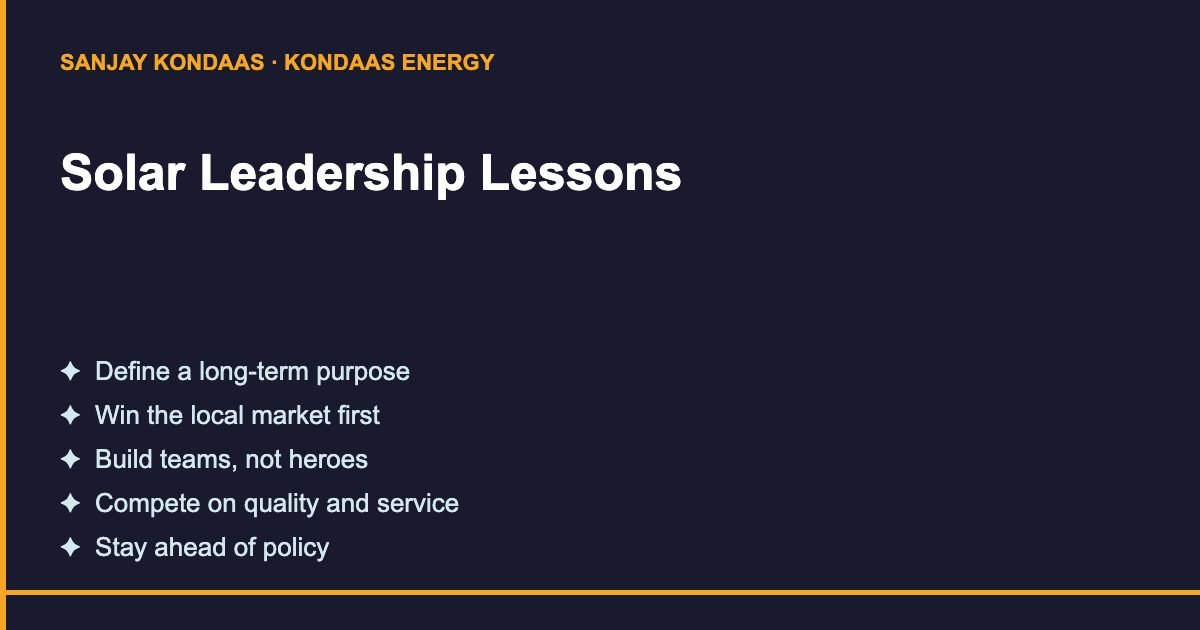
Lesson 1: Define a Clear, Long-Term Purpose
Strategic leadership starts with a purpose that outlasts market cycles. In solar, that purpose is usually about making clean, affordable power accessible. A clear purpose helps leaders say no to short-term shortcuts, such as cheap components or rushed installations, that damage reputation over time.
Lesson 2: Win the Local Market First
Most successful solar brands grow from a strong home base. Local customers can see completed projects, talk to neighbours who own systems and call the company when they need service. That local credibility becomes the platform for expansion into new districts and states.
Lesson 3: Build Teams, Not Heroes
A founder cannot personally supervise every rooftop. Strategic leadership means hiring well, training consistently and giving teams clear processes for survey, design, installation and service. Good systems allow quality to stay the same as volume grows.
Lesson 4: Compete on Quality and Service
Price wars are common in solar, but customers remember failures far longer than discounts. Leaders who choose reputable panels and inverters, honour warranties and respond quickly to service calls build referral networks that no advertising budget can match.
Lesson 5: Stay Ahead of Policy
Net-metering rules, subsidy schemes such as PM Surya Ghar and equipment regulations change regularly. Strategic leaders track these changes closely — often through updates from the Ministry of New and Renewable Energy — so their teams can guide customers with confidence.
Lesson 6: Grow Through Partnerships and Adjacent Offerings
Partnerships with strong manufacturers and expansion into related areas, such as battery storage, help solar companies serve customers more completely. Each new offering should strengthen the core business rather than distract from it.
Solar Leadership in Action: The Kondaas Example
Kondaas Energy in Coimbatore shows these lessons in practice. Founder Sanjay Kondaas started the business in 1995 with ₹10,000 after four years in sales. Over three decades, the company grew into a group with more than 200 people across Tamil Nadu and Kerala, including kPowers for products and Aurvo Energy for LiFePO4 battery storage. Kondaas is an authorised Adani solar panel distributor for Tamil Nadu and has trained more than 49,000 schoolchildren in solar awareness — an example of solar leadership that looks beyond the next quarter.
Read more in 5 proven strategic moves that turn vision into success and how a Covai startup became a solar leader.
Frequently Asked Questions on Strategic Leadership in Solar
What is strategic leadership in the solar industry? It is the practice of setting a long-term direction, building capable teams and systems, and making choices on quality, policy and partnerships that support sustainable growth.
Why do many solar companies stay small? Common reasons include competing only on price, relying on the founder for every decision and failing to build service capabilities.
How can a local solar business expand successfully? By winning its home market first, documenting its processes, investing in trained teams and expanding into related offerings like battery storage.
One thought on “From Local to Legend: How Strategic Leadership Built the National Solar Empire”